
Why WhatsApp Groups Are Bad for Selling Homemade Food (and What to Use Instead)
In 2018, a woman living in a Mumbai apartment complex started a WhatsApp group called PB Kitchen. The idea was simple: let the women in her building buy and sell each other's home-cooked dishes — a jar of pickle here, a tiffin of dal there, festive sweets around Diwali. It caught on. The New York Times and The Independent both covered it as part of a wider story about how WhatsApp was quietly reshaping the way India cooks, shares, and sells food, apartment complex by apartment complex.
That story is worth sitting with, because it's the real origin of almost every home food business selling on WhatsApp today. It wasn't built by a startup. It was built by a neighbor who saw a gap and used the tool everyone already had. There is genuinely nothing wrong with that instinct — it's free, everyone already has it, and your first customers are often people you already know. The problem isn't that WhatsApp is bad. It's that it was never built to run a business, and the cracks show up exactly when things start going well.
Maximum members in a single WhatsApp group — 2,000 across an entire Community
WhatsApp Help Center, 2026
That's not a soft guideline — it's a hard technical ceiling. A WhatsApp Community (the umbrella that links several groups together) tops out at 2,000 people total, no matter how you split it into sub-groups. If your neighborhood selling group is growing, you will eventually hit a wall where you cannot add a single new customer until someone else leaves. For a business that depends on word of mouth reaching new neighbors, that's not a minor inconvenience — it's a hard growth ceiling built into the platform itself.
The menu is always out of date
You update your menu, forward it to the group, and within a week half your new customers are still working off the old PDF someone shared three months ago. There's no single "current" version — just whatever screenshot happens to be floating around.
"Is this still available?" becomes a full-time job
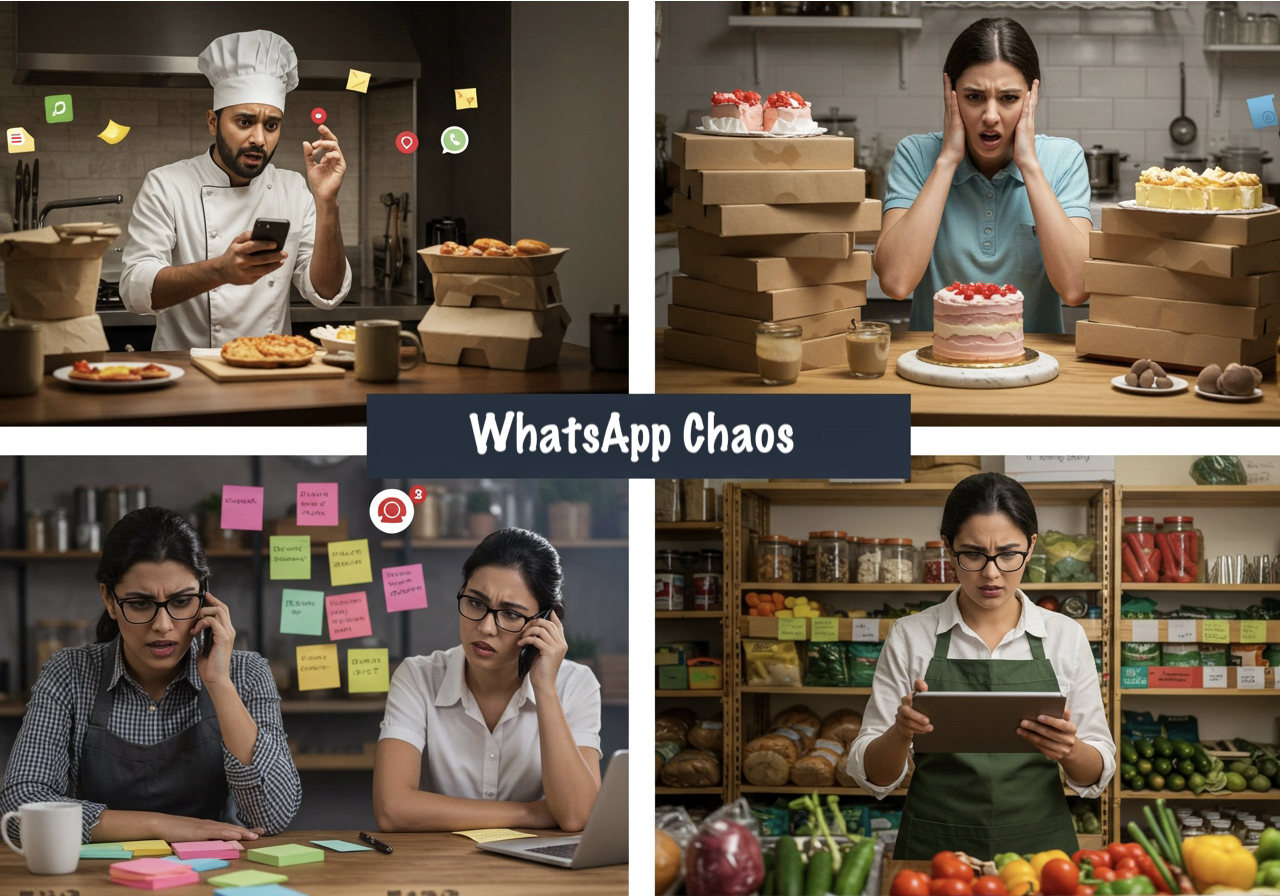
This isn't a hypothetical. On a small-business forum, one seller described their own mother's situation plainly: she sells homemade cakes on Instagram, and her order tracking is "a running WhatsApp message to herself with pending orders" — because there's no other system to hold it all. Someone else on the same forum, describing why they built order-management software for home bakers, put it this way: their sister ran a real business, with real repeat customers, entirely through "Instagram DMs, WhatsApp chats, and a notebook." Every order starts with the same back-and-forth — what's available today, what's the price, can you deliver by evening — multiplied across every customer, every single day.
New customers can't find you
A WhatsApp group only reaches people who are already in it. Someone new to your society, or a neighbor two blocks over who's never heard of you, has no way to discover that you exist — no matter how good your food is. PB Kitchen worked because it was contained inside one apartment complex where everyone already knew each other. That's a feature at a small scale and a hard limit the moment you want to grow beyond it.
There's no order history, no reviews, no trail
When a payment screenshot gets lost in the chat, or a customer disputes what they ordered, you have nothing to point back to. And there's no visible track record of happy customers to help convince the next hesitant buyer — the trust PB Kitchen ran on had to be rebuilt, from scratch, in every single new conversation.
The trust PB Kitchen ran on just needs a place to actually live.
What a real storefront changes
- One current menu that's always accurate — no more outdated screenshots
- Buyers browse and order without you manually answering every question
- New neighbors can discover your store, not just people already in a 1,024-member group
- Order history and reviews build trust automatically, order after order
This is exactly what MyPadosi is built for: a structured storefront for home-based sellers, without needing any technical setup. You keep the personal, neighborhood feel that made PB Kitchen work in the first place — you just stop being limited by a member cap and a notebook full of pending orders.
Ready to start selling home chefs?
See how MyPadosi helps sellers in this category get discovered.